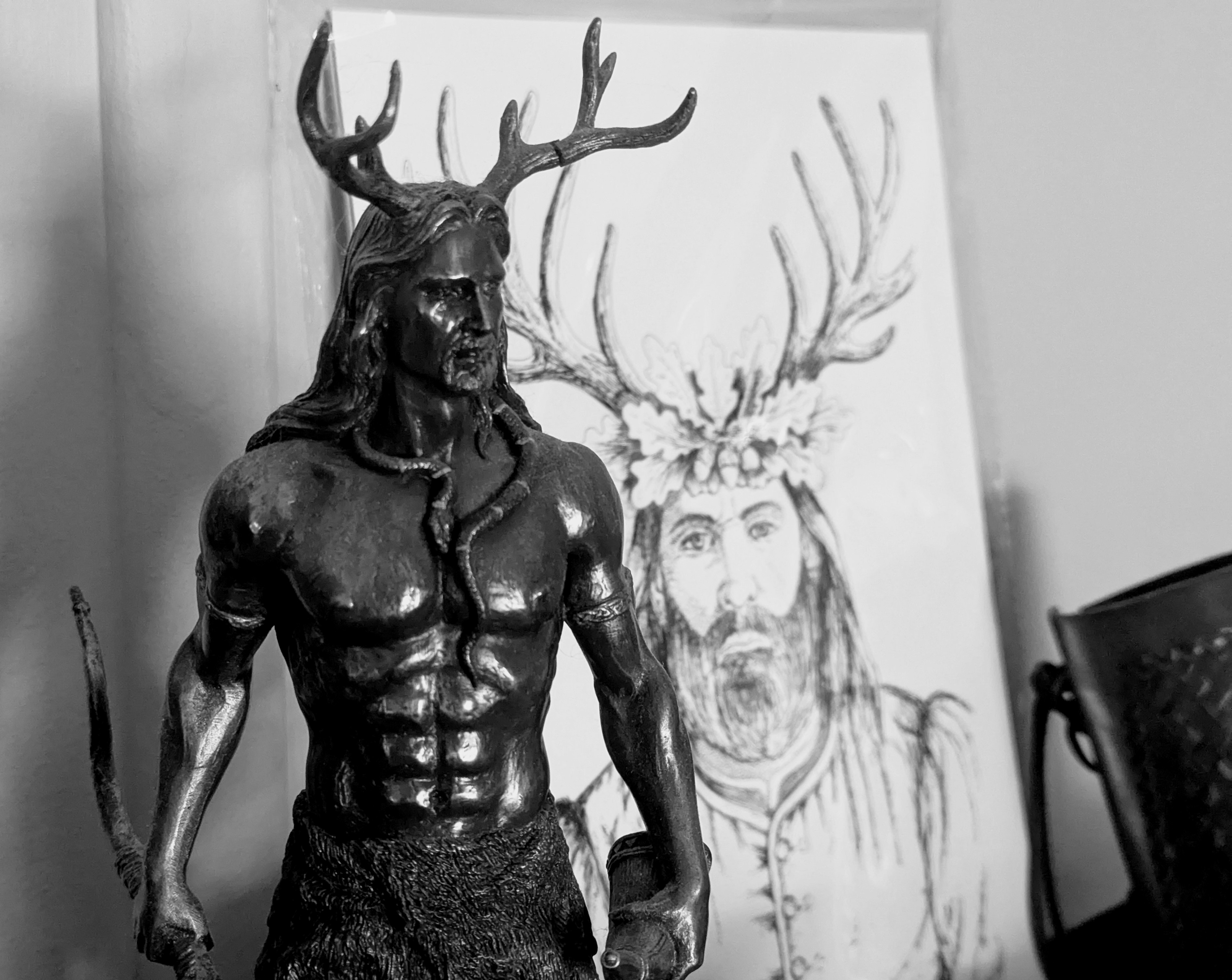
Oh no, it happened again! I replayed another question from the upcoming podcast with Voices of the Temple in my mind, and I’m frustrated with how I answered it.
This, my friends, is the downside of trying to think while recovering from a brand-new neurological diagnosis and drinking the equivalent of three cups of coffee at 4am.
(No, I joke – I was able to study ahead of time. I’m still frustrated with the answer I gave, though.)
ANOTHER misconception about Herne the Hunter is that he is purely associated with death, retribution, and the Wild Hunt.
He is, of course, all of those things, and they play a major part in his origin story – particularly in Ainsley’s version, Herne’s connections to Odin and local folklore. However, reducing Herne solely to those aspects is a bit like saying someone who plays football is only ever a footballer, while completely disregarding their other talents, interests, personality traits, achievements, and (depending on the individual) scandals.
To focus exclusively on Herne as a Leader of the Wild Hunt is to miss so many of his other qualities and offerings.
This is one of the reasons I felt it was so important to include an entire section in the book dedicated to his archetypes. I wanted to bring attention to the aspects of Herne that are often overlooked, dismissed, or brushed aside as “not really Herne” because people have become so attached to the image of him as a vengeful leader of spectral riders charging through the night.
Importantly, if you’ve come here specifically to discuss Herne as a Leader of the Wild Hunt – or if you’d simply like to know more about the Wild Hunt throughout Britain – may I direct you to a wonderful book by Hugh Williams, The Horn of Mercia. It takes readers on a journey through Mercia and Britain, weaving together the folklore, history, and enduring mystery of the Wild Hunt.
I mention on the podcast that my favourite misconception about Herne is when people assume that Herne and Cernunnos are interchangeable.
They. Are. Not.
It is the equivalent of comparing a set of twins.
Or perhaps comparing Mark Dacascos and Brandon Lee. Yes, they both played The Crow, but they each brought something entirely different to the role.
Just… please don’t. Please. It’s rude.
Appreciate them individually for their own talents and contributions.
The same applies to Herne and Cernunnos.
Cernunnos is ancient, primal, and (assumingly) thousands of years old. Herne, by comparison, has a much more recent starting point in folklore and legend. Their stories developed in different cultural contexts and their energies are distinctly their own.
Of course, being compared to Cernunnos is an honour. In my experience, that comparison has been one of the factors that has allowed Herne to shift within the Spirit Realms and rise into a new energetic vibration as a Deity. Yet despite these overlaps, they remain very individual beings.
That said, the wholeness of the Horned God archetype lends itself beautifully to Herne because it complements the darker elements of his character rather than replacing them.
The Horned God represents the bounty of Spring, the fullness of Summer, and – in Australia, particularly – the sometimes brutal harshness of Summer as well. He embodies the strength of the rutting stag, fertility, virility, sexual heat, and raw life force.
This is Herne not as death, but as life in its fullest expression.
Then there is Herne as the Forest Guardian.
Here we find connections to The Merry Wives of Windsor, local folklore surrounding Herne, and the liminal realms of the Fae. In some ways, this aspect draws closer comparisons to Gwynn ap Nudd than it does to the Wild Hunt itself.
When I think of Herne as the Forest Guardian, I don’t see storm clouds and spectral hounds: I see lush green canopies, and flowers in bloom. I envision ancient trees standing watch over hidden pathways.
I see a protector. A champion of all those who dwell within his Forest Realm.
When we think of horned figures in folklore, we often leap immediately to fearsome imagery. Yet many of these beings stand at the threshold between worlds. They are wardens as much as they are wanderers.
Herne’s presence at the boundaries of the forest speaks to this protective quality. He watches over the wild places and those who seek refuge within them.
In fact, I believe this is how many modern practitioners first encounter him. It was years into practicing and honouring Herne that I was allowed (very specific word here) to see him as a rider of the Wild Hunt. In my early days in particular, he was always a steady and reassuring presence.
Herne is a figure who stands between the riders and the things that would do them harm. A protector of the overlooked, the outcast, and the lost.
And perhaps this is why reducing Herne solely to the Wild Hunt feels incomplete.
The Wild Hunt is undeniably important. It is one of the most compelling and dramatic aspects of his mythology, and one that has captured imaginations for generations.
But it is not the whole story.
Herne is shadow and sunlight. He is death, but also vitality.
He is winter branches silhouetted against a storm-dark sky and the vibrant green shoots that emerge when the season turns.
He is the cry of hounds in the darkness and the quiet stillness of a forest glade at dawn.
To know Herne only through vengeance is to know only one face of a much larger mystery.
The challenge here, and perhaps the gift, of working with Herne is allowing him to be all that he is. Not forcing him into a single role, a single title, or a single mythology, but appreciating the complexity that has allowed his legend to endure, evolve, and continue speaking to people today.


Leave a Reply