At this moment in time, I am very thankful that everything happening with me regarding Functional Neurological Disorder (FND) is happening after the book.
I’ve never had great vision (I’ve worn glasses since June 1993), but now I have distance glasses, readers, and a growing collection of little reminders that my eyes are changing in ways I’d rather it didn’t.
I’ve never had a great memory either.
If you’ve read this blog over the last fifteen years or so, you’ll probably have come across me complaining about just how rubbish my memory is. It’s been an issue for as long as I can(‘t) remember, but lately it feels different. Appointments are forgotten if they’re not on the calendar, the keys need to live in one of two set places. It feels like I’m forgetting some of the little things that make me… me.
Many moons ago, one psychiatrist refused to give me a diagnosis (fifteen years later it turned out to be Asperger’s) because she was worried I would “act to it”. That conversation still pops into my head from time to time, particularly now when I’m having a rough day, I’m exhausted, and I know that the FND likes to misbehave when I’m tired. But I sometimes wonder whether my brain has gathered up the labels I’m collecting like Pokemon — Asperger’s, FND, C-PTSD, OCD and anxiety — and is choosing to clutch them like a favourite childhood toy. Whether that’s true or not isn’t really the point; it’s simply one of the places my mind wanders when I’m trying to make sense of what is changing.
What prompted this post, though, was something much smaller.
I’ve noticed that my fingers don’t dance across the keyboard the way they used to.
I’ve never been someone who watched their hands while typing—and these days there’s even less point because, readers or not, I can’t properly see the keys anyway—but the number of little mistakes I make now is enough to drive me into quiet bursts of frustration.
Losing words in conversation? I can work around that. I sigh, I pause, I choose different words. Communication still happens, even if the route is a little more scenic.
Typing feels different.
I’m saying I just had to type and re-type that final “I’m” six times before I was able to get it right and move on.
Six.
It seems like such a small thing until you realise that writing is made up almost entirely of thousands upon thousands of small things.
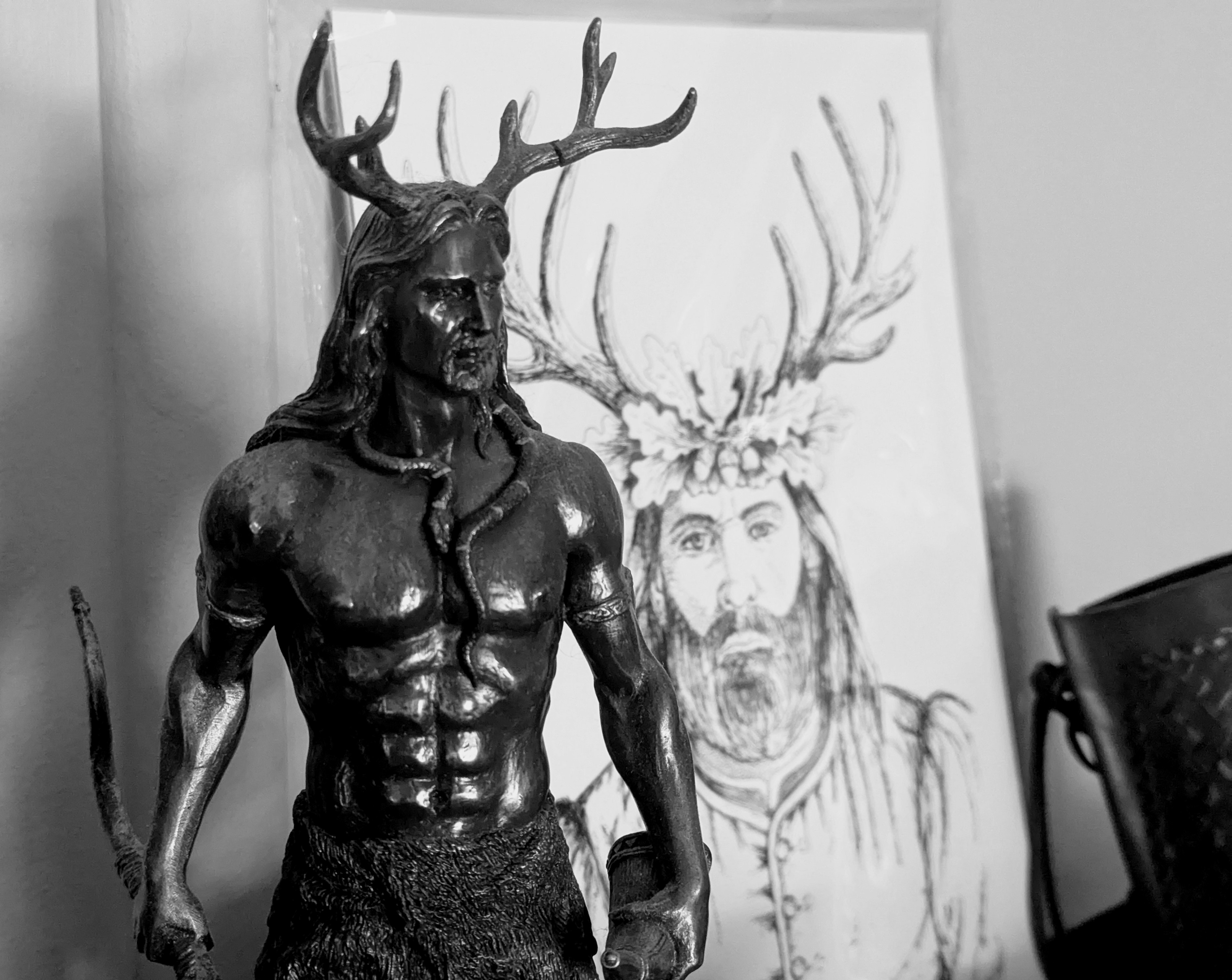
Had these problems started while I was writing Herne the Hunter: Myth, Legend and Devotion of the Horned God, I genuinely don’t know whether I would have finished it.
Perhaps this is just a whinge. It’s more than likely me trying to process from grief. I haven’t been able to see a psychologist yet, and I see my Neurologist again after I see the psychologist.
Living with a chronic neurological condition is about constantly finding new habits, new rituals, and new ways of doing ordinary things that are beyond the scope of “here are some symptoms that not everyone gets that you’re going to have to manage”. Every adjustment costs a little energy, and lately so much of that energy has gone into adapting that I haven’t really stopped to celebrate physically holding the finished book.
Which feels rather ironic, and not because the FND diagnosis came the day after the US release, but because the book has quietly become something else. With all ego set aside, it has become an extension of my memory.
I carry a copy with me not because I want people to see it, but because sometimes I need it. I can open it and remind myself what I wrote. I can revisit prayers, ritual structure, and thoughts that I know came from me, even when I struggle to recall them unaided.

It’s like having memories tied to photographs. I don’t remember having attending my brothers 2nd birthday party at Ollie’s, a now defunct restruant from the 1980s, but there’s a particular photo of my brother that sat on my Nan’s spare room dresser. I remember that photo, which makes me remember a slide, and a particular moment.
I am having to use my own book like photographs to trigger memories because otherwise, they’re just not there anymore.
I can remember my morning routine like a song that’s been etched into my mind through repetition, but I can’t always remember the ritual structure I’ve used for years to celebrate the Winter Solstice.
Thankfully, I wrote some of them down.
Perhaps that’s one of the quiet gifts of writing – it preserves our ideas for other people, but that sometimes it preserves a little piece of ourselves for the days when we need to find our way back to them.


Leave a Reply